St Joseph’s Waterton Hall, run by the Sisters of St Joseph’s, opened in 1951. It was a boarding school in Rowella for girls aged between 6 and 12. In 1952, the School became an approved institution for British child migrants but it never received any. It appears to have closed in the late 1960s or early 1970s.
In Orphans of the empire, Alan Gill refers to St Joseph’s Waterton Hall as a Tasmanian institution that received child migrants. However, the Senate’s Lost innocents report noted that, apart from Gill’s book, no other source mentioned this. The confusion has probably occurred because, although Waterton Hall became an approved institution for child migrants, it never received any.
The first hint that Waterton Hall intended to apply for child migrants came in a Launceston Examiner article, published in July 1949. Exactly one year later, Archbishop EV Tweedy lodged the application.
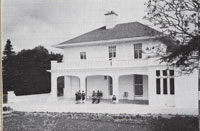
The application shows that the school was set on 90 acres and had an orchard, dairy and poultry farm. The house, which was made of stone, brick, and weatherboard, had two storeys and fourteen rooms. The school was not yet operating but there were plans to take 15 child migrants as well as boarders and day students. The application specified that: ‘St Joseph’s is not an Orphanage or an Institution but is a Boarding School to which also Tasmanian girls from country districts will go’.
On 30 April 1951, the school opened with 18 boarders and seven day students, the children of Dutch migrants living on the estate. Their fathers worked on the farm and their mothers as domestics in the school.
British authorities insisted that migrant children living in institutions must experience family life. Unlike St Joseph’s Orphanage, the sisters at Waterton Hall had no objections to this. Instead they intended to foster outside contacts by placing the migrant girls in private homes on weekends and for holidays. The sisters anticipated that the parents of other students would be keen to take them for visits.
The application stated that when the migrant girls reached 12 years of age, they would go to St Mary’s College, Hobart or St Joseph’s College, Launceston, mostly to learn domestic science or commercial subjects. Those with particular ability would go onto technical college.
On 13 February 1952, St Joseph’s Waterton Hall became an approved institution for child migrants. However, it never received any. By then the flow of Catholic migrant children, especially girls, had begun to decrease. In addition, the school failed to receive State or Commonwealth government money to build an extension for the migrants. This made it less likely that they would receive them because institutions with Commonwealth funds for building had priority. On 5 July 1960, the government cancelled the school’s status as an approved institution for child migrants.
The Catholic Church, which had owned Waterton Hall since 1949, retained it until 1996. After the School closed, it used the buildings for the Commonwealth funded Trident Outdoor Recreation Scheme which took Catholic students from High Schools in Tasmania. Between 1978 and about 1991, the St Vincent de Paul Society used the buildings as a hostel for homeless boys. Since then Waterton Hall has been a retreat and, in 2013, it is a winery.