Want some help?
Does this page need updating?
Look for Similar
Other Find & Connect resources
Organisation Contagious Diseases Hospital (1879 - 1900)
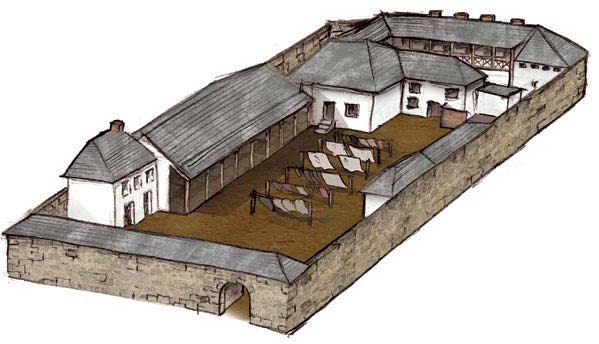
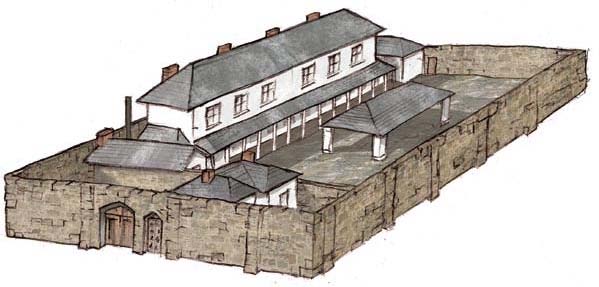
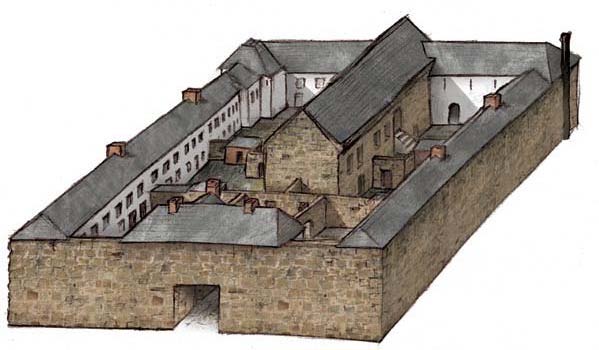
Yard 4 at the Female Factory, Cascades, courtesy of Female Convicts Research Centre Inc..
Details
- From
- 1879
- To
- 1900
- Categories
- Care Provider and Government-run
- Alternative Names
- Lock Hospital
- Prison Lock Hospital
Summary
Please note that this page reproduces the original language used in the historical sources drawn upon to compile this entry. This language includes offensive and derogatory terms which are today considered unacceptable. We apologise for any offence caused by such language.
The Contagious Diseases Hospital, initially run by the government, was established under the 1879 Contagious Diseases Act. It was situated in almost all of Number 1 and Number 2 Yards at the Female Factory, Cascades. In 1891, it moved to No. 4 Yard. In 1895, in conjunction with representatives from some other institutions, the Home of Mercy, a rescue home also located in No. 4 Yard, took over the management of the Contagious Diseases Hospital. The Hospital closed in 1900.
Details
The Contagious Diseases Hospital operated under the Contagious Diseases Acts 1879, 1881 and 1882 which provided for the compulsory treatment of women with sexually transmitted diseases, especially syphilis. Most of the patients were aged between 16 and 45. They remained in the hospital for between 2 and 12 weeks. The government expected to cater for large numbers of patients and so initially they allocated almost all of Number 1 and Number 2 Yards to the hospital. Despite these expectations, only about 100 women were treated each year. On average, 50 of those were in the Hospital voluntarily.
The Hospital had 2 wards. According to the Superintendent, Dr John Coverdale, the largest was for the 'worst chararcters', and the other for the 'less depraved'. He placed the 'more difficult' patients in solitary confinement. In 1880, the Administrator of Police criticised the Matron for not supervising the wards once the young women were locked up for the night. Coverdale replied that no one was willing to stay in the wards at night and if they did would be unable to defend themselves.
In So much hard work, Kay Daniels wrote that, between 1879 and 1890, parents or the police occasionally took children to the Hospital. From the 1890s onwards, children were increasingly placed there, although the reason why is not clear. In 1900, the Secretary of the Neglected Children's Department sent a 10 year old girl to the Hospital.
Arnot suggests that contagious diseases hospitals in general were 'actually more like prisons than hospitals'. This aptly describes the Contagious Diseases Hospital at Cascades which apparently had a grim reputation. In 1884, the Superintendent of Police, suggested that women dreaded a sentence in the Hospital more than prison.
Location
- 1879 - 1891
- The Contagious Diseases Hospital was situated in Number 1 and Number 2 Yards at the Female Factory, Cascades, South Hobart. Location: South Hobart
- 1891 - 1900
- The Contagious Diseases Hospital was situated in Number 4 Yard, Female Factory, Cascades, South Hobart. Location: South Hobart
Related Entries
Publications
Books
- Brown, Joan C., 'Poverty is not a crime': the development of social services in Tasmania, 1803-1900, Tasmanian Historical Research Association, Hobart, 1972, 192 pp. Details
Book Sections
- Arnot, Meg, 'The Oldest Profession in a New Britannia', in Burgmann, V. and Lee, J. (eds), Constructing a Culture: A People's Identity of Australia, McPhee Gribble, Melbourne, 1988, pp. 42-62. Also available at http://www-old.infoxchange.net.au/wise/HEALTH/Pros1.htm. Details
- Daniels, Kay, 'Prostitution in Tasmania', in Daniels, Kay (ed.), So much hard work: women and prostitution in Australian history, Fontana/Collins, Sydney, 1984, pp. 15-86. Details
Reports
- Scripps, L. and Hudspeth, A, The Female Factory Historic Site: Historical Report, unpublished report for Department of Parks, Wildlife and Heritage, 1992. Details
Theses
- Parry, Naomi, ''Such a longing': black and white children in welfare in New South Wales and Tasmania 1880-1940', Thesis, University of New South Wales, 2007. Details
Online Resources
- 'Cascades Female Factory Ruins', in Australian Heritage Places Inventory, Australian Government, http://www.heritage.gov.au/cgi-bin/ahpi/record.pl?RNE11027. Details
- Tasmanian Heritage Council, Proposed Amendment to the Tasmanian Heritage Register entry for the Cascades Female Factory, South Hobart. Information Package., 2007, http://www.femalefactory.com.au/pdfs/Cascades_datasheet%20_5Nov07.pdf. Details
Gallery
Sources used to compile this entry: Arnot, Meg, 'The Oldest Profession in a New Britannia', in Burgmann, V. and Lee, J. (eds), Constructing a Culture: A People's Identity of Australia, McPhee Gribble, Melbourne, 1988, pp. 42-62. Also available at http://www-old.infoxchange.net.au/wise/HEALTH/Pros1.htm; Brown, Joan C., 'Poverty is not a crime': the development of social services in Tasmania, 1803-1900, Tasmanian Historical Research Association, Hobart, 1972, 192 pp; 'Cascades Female Factory Ruins', in Australian Heritage Places Inventory, Australian Government, http://www.heritage.gov.au/cgi-bin/ahpi/record.pl?RNE11027; Scripps, L. and Hudspeth, A, The Female Factory Historic Site: Historical Report, unpublished report for Department of Parks, Wildlife and Heritage, 1992; Tasmanian Heritage Council, Proposed Amendment to the Tasmanian Heritage Register entry for the Cascades Female Factory, South Hobart. Information Package., 2007, http://www.femalefactory.com.au/pdfs/Cascades_datasheet%20_5Nov07.pdf.
Prepared by: Caroline Evans
Created: 15 March 2011, Last modified: 5 April 2013