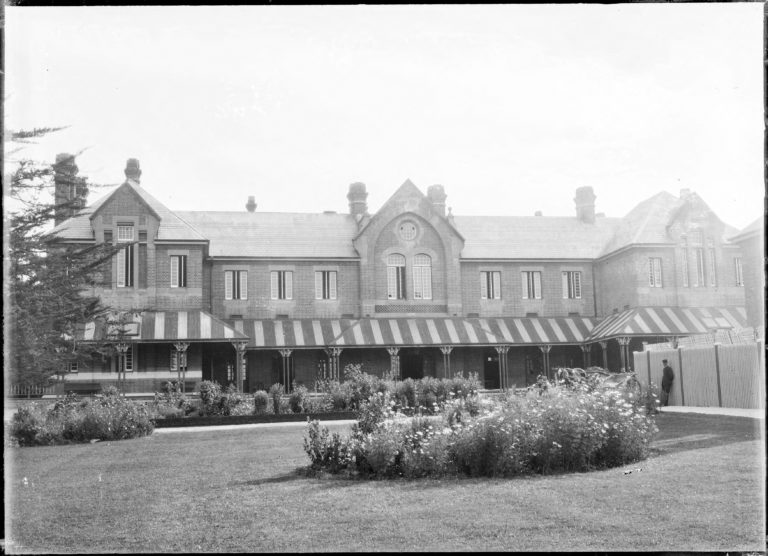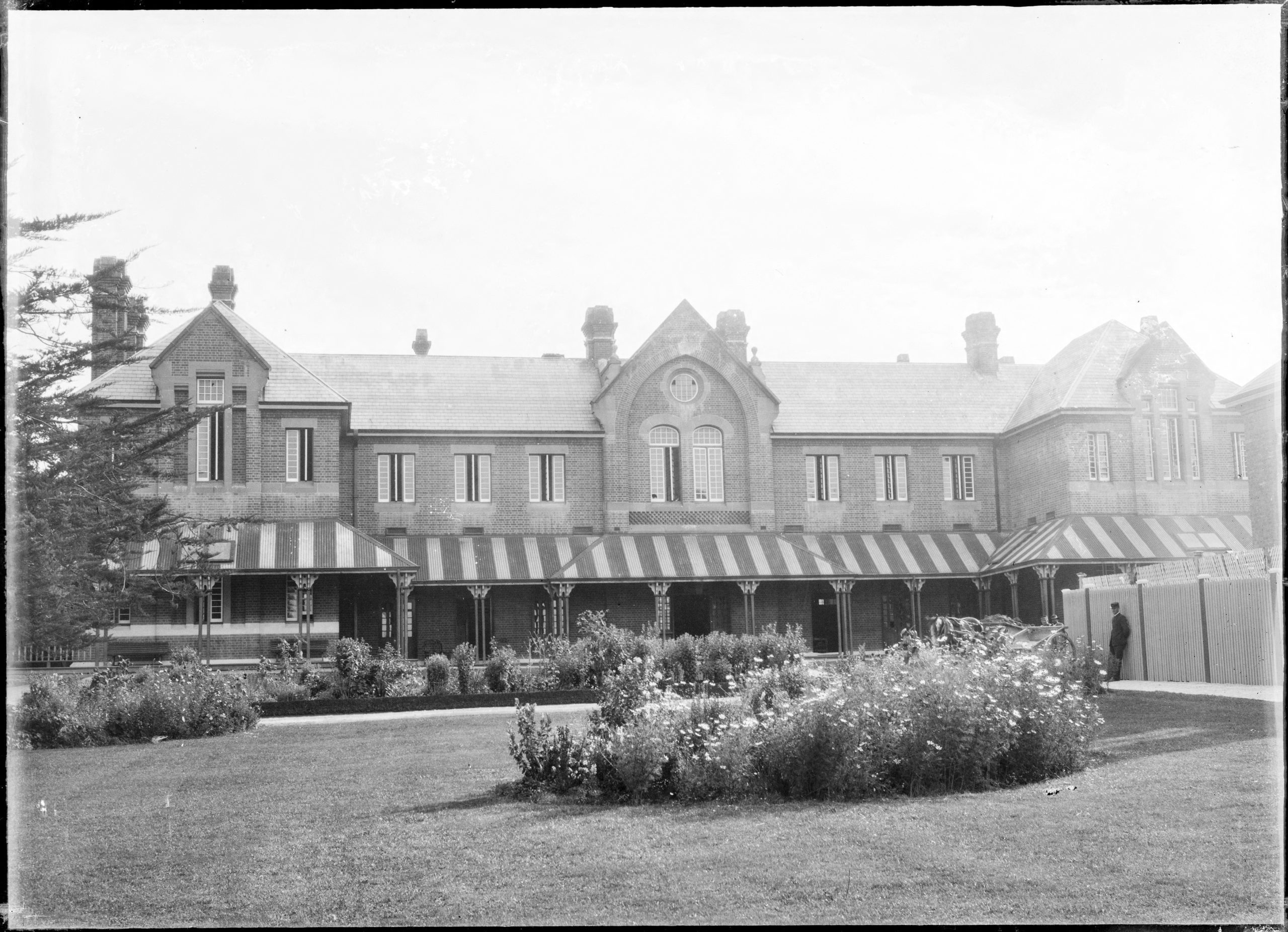
Lachlan Park Hospital, run by the government, replaced the Mental Diseases Hospital in 1937. It was in New Norfolk. Lachlan Park was a secure mental asylum which, in addition to adults, held children and adolescents, including wards of State. In 1968, it became part of the Royal Derwent Hospital.
Lachlan Park was on the western side of the Lachlan River in New Norfolk surrounded by a high wall and locked gates with security guards.
In 1940, Bronte House became the Boys’ Cottage and the former Boys’ Cottage, L Ward, became M Ward for women and girls. Children housed in these wards were adolescents. Lachlan Park also had a children’s ward known as Alcheringa or Myrtle Ward. In 1941, instead of abandoning the Gentleman’s Cottage, built in 1859, as planned, it became an institution for men and boys with intellectual disabilities. St John’s Park, where they lived, was overcrowded. The Cottage was demolished in 1964.
Most parents placed their children at Lachlan Park on the advice of doctors because of an intellectual or severe physical disability. These conditions carried a social stigma and parents who attempted to raise the children themselves received no government or community support. Other children were wards of state or had been under the guardianship of the Mental Deficiency Board. The Hospital assumed guardianship of them once they were transferred.
In a submission to the Senate Inquiry into Children in Institutional Care, a former ward of state described her time at Lachlan Park during the 1950s. The Sisters at the Magdalen Home had arranged her transferral to the Children’s Ward there because they found her behaviour difficult to manage. She helped look after the younger children on the ward. In her submission, she recalled the distressing lack of care and abuse that the children received. When the young woman tried to escape, after attempts to sedate her, she was transferred to another ward where she was put in a cell with a ‘small peephole’ in the door.
Margaret Reynolds, who was a teacher before she became a senator, taught at Lachlan Park Special School, located in the grounds of Lachlan Park, in 1963. In her autobiography, she writes that the asylum was a ‘dumping ground’. Reynolds remembers her first visit to the Children’s Ward. She too describes the disturbing situation of the children and the lack of any meaningful stimulation. Several children with paralysis or an intellectual disability were tied to their beds.
Later Reynolds discovered that there were other children in the asylum. Girls over 10 were scattered throughout the adult wards. Even J Ward, a maximum security ward for disabled adult women, occasionally held girls with ‘behaviour problems’. These wards lacked basic hygiene and the children witnessed the upsetting behaviour of some of the adult patients.
About 40 boys lived in a separate secure ward close to the school. Reynolds often heard the sound of boys being beaten. They had few activities to engage them. Some of them did not have intellectual disabilities but were juvenile offenders, placed at Lachlan Park because it was the only secure unit available, apart from Risdon Prison.
Plans to close Lachlan Park go back to 1944 when Dr Catarinich, Victoria’s Director of Mental Health, condemned the buildings as too crowded, out-of-date, unhygienic, and structurally unsound. He suggested that it be replaced with a new hospital. In 1949, following a Parliamentary Standing Committee recommendation, the government decided to build a new mental hospital on the eastern side of the Lachlan River. It opened in 1968 as the Royal Derwent Hospital. However, Lachlan Park was not abandoned. Instead as part of the new hospital, it was used exclusively for people with intellectual disabilities.
The Ombudsman received 10 claims in the lead up to the Review of claims of abuse from adults in state care as children: Final Report – Phase 2 of 2006.
From
1937
To
1968
1937 - 1968
Lachlan Park was on Humphrey Street, New Norfolk, Tasmania (Building Still standing)
Previous
Subsequent