Want some help?
Does this page need updating?
Look for Similar
Other Find & Connect resources
Organisation Wingfield House (1938 - 1971)
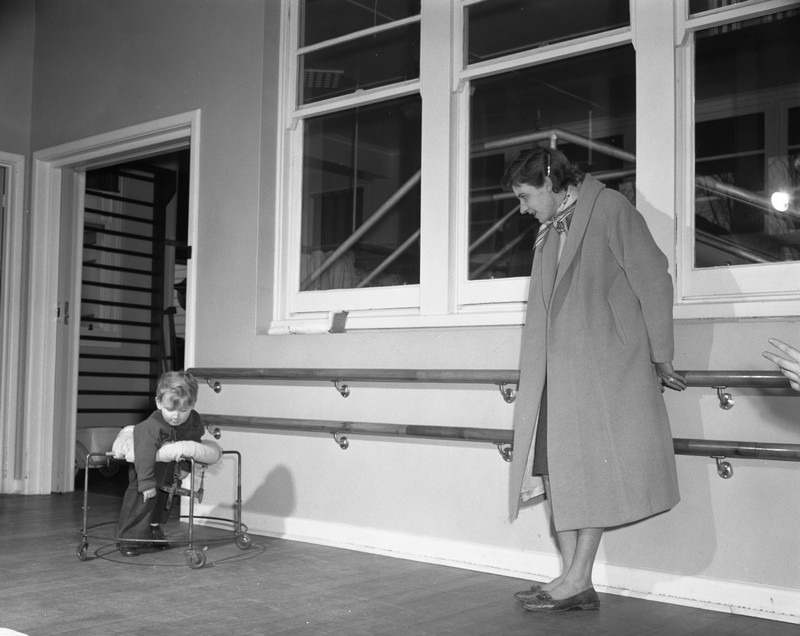
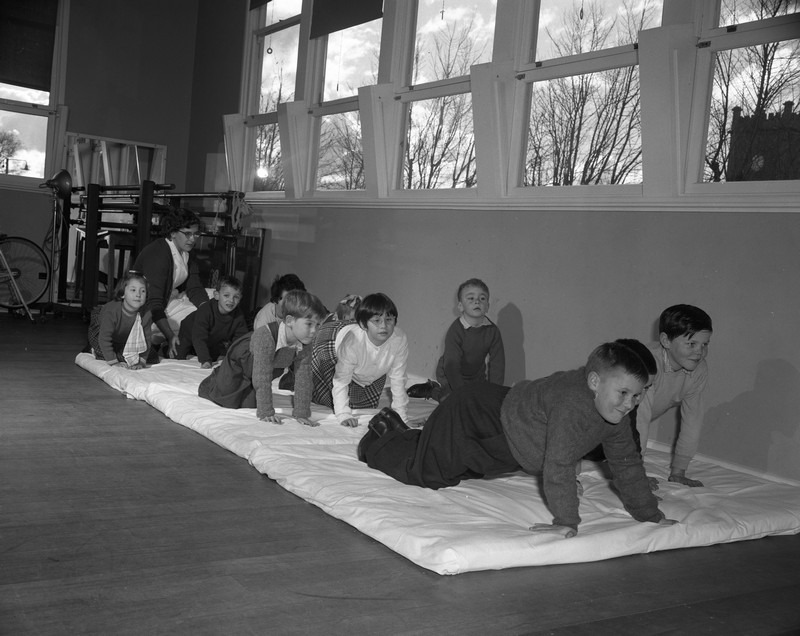
Wingfield Home, Physiotherapy Department gym, class work for cerebral palsied children to teach control and strength, 1951 - 1973, courtesy of Tasmanian Images: Tasmanian Archive and Heritage Office.
Details
- From
- 1938
- To
- 1971
- Categories
- Care Provider and Disability Institution
- Alternative Names
- Wingfield Home
Summary
Please note that this page reproduces the original language used in the historical sources drawn upon to compile this entry. This language includes offensive and derogatory terms which are today considered unacceptable. We apologise for any offence caused by such language.
Wingfield House began receiving children in 1938 and was officially opened on 9 November 1940 by the Governor, Sir Ernest Clark. It had been built on the grounds of New Town Rest Home by the Tasmanian Society for the Care of Crippled Children. Wingfield provided residential and outpatient aftercare to children affected by the polio epidemic of 1937 to 1938. Later it offered services to children with a range of physical disabilities.
Details
At the opening, according to the Mercury, the Governor said that 'the gift to all who were well and strong was the power to help others and that gift was given in abundance to the devoted nurses who cared for the helpless patients'. He hoped that the Home would be '"conducted in such a spirit of Christian benevolence that the patients will be cared for with every kindness and every scientific facility fully utilised for their recovery."'
The first wing of the building had been finished in 1938. The Tasmanian Society for the Care of Crippled Children funded it with a portion of the gift given to the Australian government by Lord Nuffield for the care of children with physical disabilities. Wingfield was named after Lord Nuffield's Hospital in Nottingham. An extension, named the Shugg Wing after a Hobart paediatrician, opened in 1941. After the opening, the Society handed Wingfield over to the Board of the Royal Hobart Hospital.
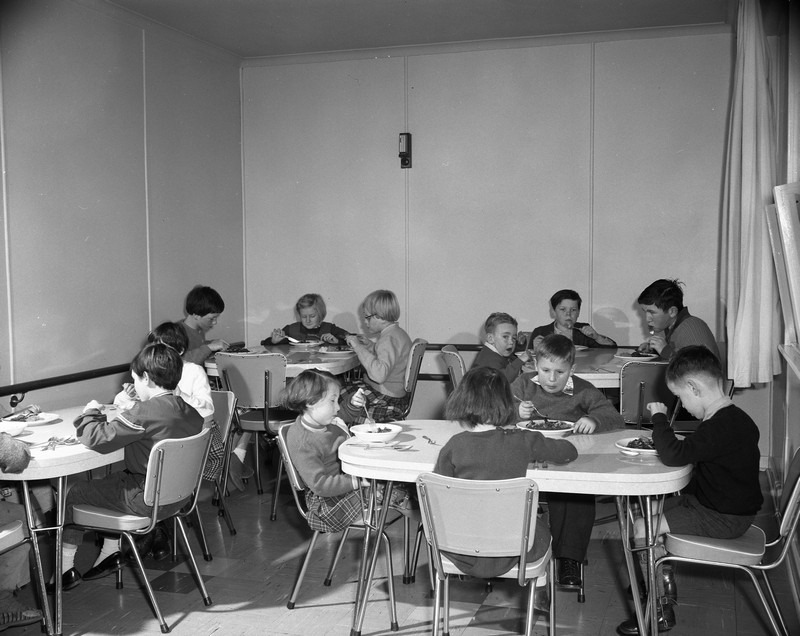
A 1941 menu shows that the children had a set meal for every day of the week. They always had porridge for breakfast, followed by eggs, chops, lamb's fry, bacon or sausages. They had two courses for their midday meal with meat, potatoes and another vegetable for the first course and steamed pudding, rice or sago custard, or bread and butter custard for the second. At tea time, they usually had meat again, sometimes followed by a dessert of blanc mange, jelly, preserved fruit, or cornflakes. Five years later, the diet appears to have been less varied. The Director of Hospital and Medical Services received a complaint because on several evenings the meal had been saveloys. He told the Matron that the children should be offered more choice and suggested soup, custards, junket, stewed fruit, bread and butter pudding, scrambled eggs, mince, bread, butter, jam, and Bournvita or weak tea.
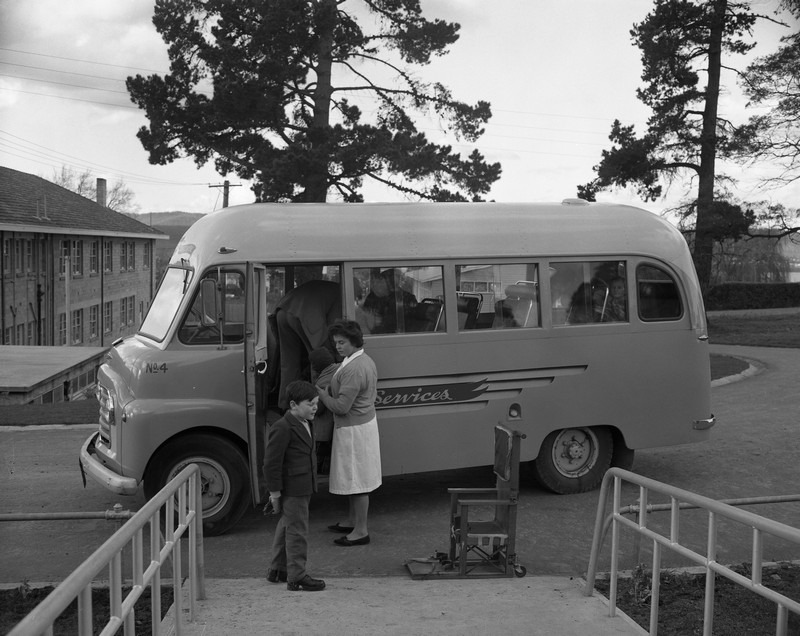
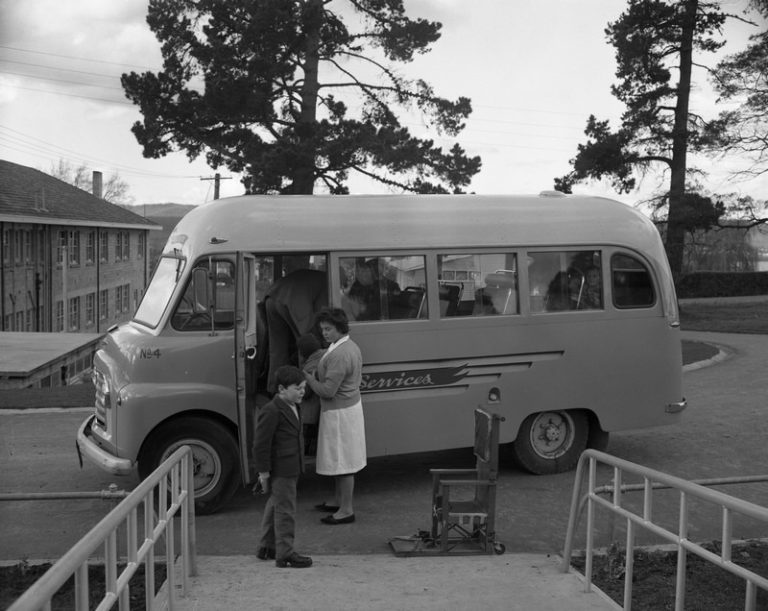
There was a Wingfield Outings Club that took children on day trips, In 1946, they took 146 children and 39 nurses out on 24 occasions. They covered 1,463 miles. Members took part in at least one outing each but some went on more than that. According to the Annual Report of the Club:
All passengers were carried safely and no mishaps occurred. Weather conditions have been generally favourable and no Outing [sic] has had to be postponed on this account. The places visited have been many and varied.
In a series of 4 oral history interviews conducted for an Arts Tasmania funded project enititled 'I stand corrected', its coordinator, James Newton, found that patients from Wingfield House were sometimes transferred back to the children's ward at the General (now Royal Hobart) Hospital when their conditions improved. From there, they were sent to work as therapy in the orthopaedic workshop that was attached to the hospital. Sometimes they received low wages, at other times, no payment at all. Some eventually went on to do apprenticeships in the trade.
In 1957, 14 children lived at Wingfield. They had a range of illnesses including Little's Disease, TB, and polio. Wingfield later took adult patients as well as children.
Location
- 1938 - 1971
- Wingfield House was in New Town. Location: New Town
Related Entries
Publications
Books
- Killalea, Anne, The great scourge: the Tasmanian infantile paralysis epidemic 1937-, Tasmanian Historical Research Association, Hobart, 1995, 165 pp. Details
- Pearce, Kim and Doyle, Susan, New Town: a social history, Hobart City Council, Hobart, 2002, 144 pp. Details
Online Resources
- 'Wingfield House: Dr Cumpton praises work of Tasmanian society', The Mercury, 11 November 1940, p. 4, http://nla.gov.au/nla.news-article25832887. Details
- 'Vice-Regal visit to Wingfield House', The Mercury, 13 November 1940, p. 4, http://nla.gov.au/nla.news-article25833254. Details
- 'Separation of inmates: need at Wingfield', The Mercury, 30 April 1941, p. 8, http://nla.gov.au/nla.news-article25859060. Details
- 'Teatime', The Mercury, 9 December 1944, p. 4, http://nla.gov.au/nla.news-article26048661. Details
- 'Merry moments at Wingfield House', The Mercury, 14 December 1944, p. 5, http://nla.gov.au/nla.news-article26029673. Details
- 'Party at Wingfield', The Mercury, 20 December 1946, p. 4, http://nla.gov.au/nla.news-article26374905. Details
- 'Stories for children at Wingfield', The Mercury, 4 August 1948, p. 1, http://nla.gov.au/nla.news-article27757117. Details
- 'Wingfield holiday', The Mercury, 31 August 1938, p. 12, http://nla.gov.au/nla.news-article27772842. Details
- 'Thrill for polio sufferers', The Mercury, 8 July 1952, p. 3, http://nla.gov.au/nla.news-article27098015. Details
Gallery
- Title
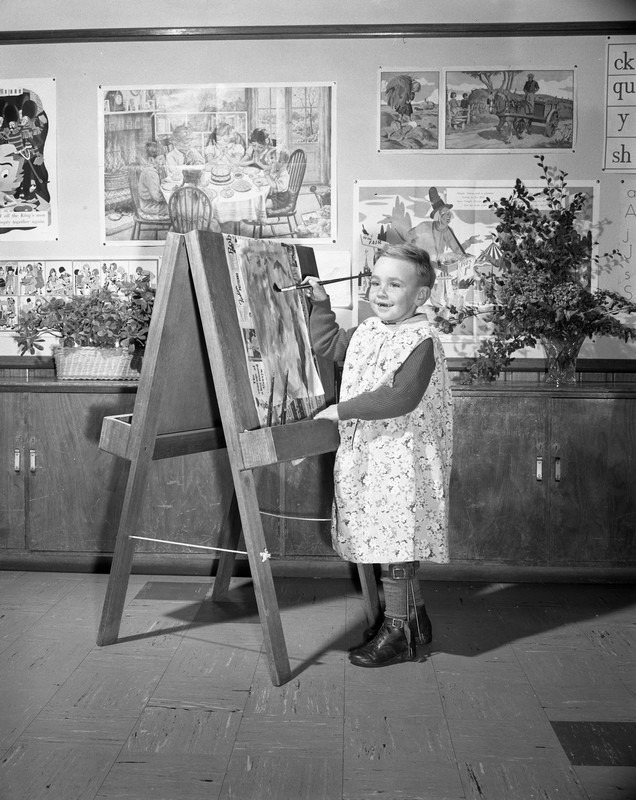
- Wingfield Home, classroom, paints and brush provide a valuable medium of self expression
- Type
- Image
- Date
- 1951 - 1973
- Control
- TAHO Reference: AB713-1-7660
- Source
- Tasmanian Images: Tasmanian Archive and Heritage Office
- Title
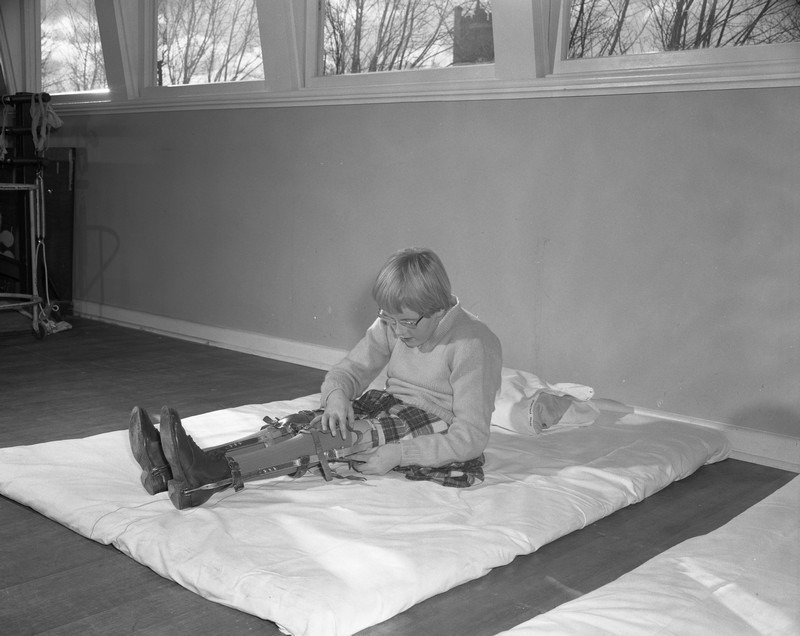
- Wingfield Home, Physiotherapy Department gym, children wear long callipers (jointed) to correct knee flexion problem, child 11 years can cope with own callipers
- Type
- Image
- Date
- 1951 - 1973
- Control
- TAHO Reference: AB713-1-7662
- Source
- Tasmanian Images: Tasmanian Archive and Heritage Office
- Title
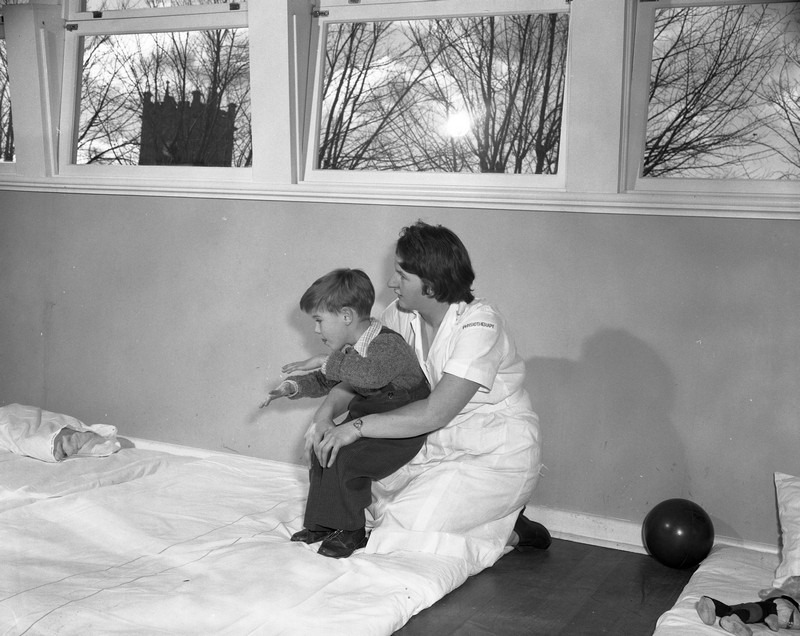
- Wingfield Home, Physiotherapy Department gym, one of a series of exercises used to re-educate strength and control for standing
- Type
- Image
- Date
- 1951 - 1973
- Control
- TAHO Reference: AB713-1-7664
- Source
- Tasmanian Images: Tasmanian Archive and Heritage Office
- Title
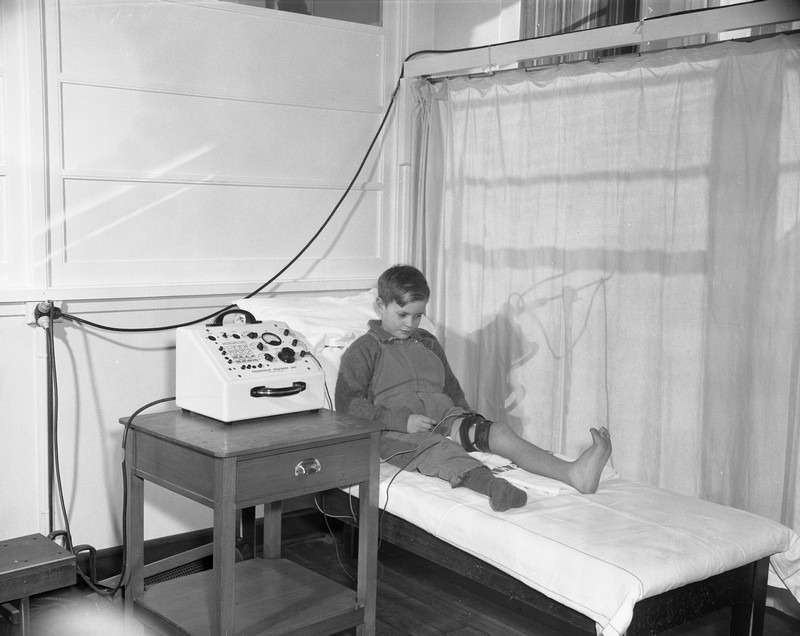
- Wingfield Home, Physiotherapy Department gym, electrical stimulation of muscle to improve power in early stage of re-education
- Type
- Image
- Date
- 1951 - 1973
- Control
- TAHO Reference: AB713-1-7666
- Source
- Tasmanian Images: Tasmanian Archive and Heritage Office
- Title
- Wingfield Home, Physiotherapy Department gym, class work for cerebral palsied children to teach control and strength
- Type
- Image
- Date
- 1951 - 1973
- Control
- TAHO Reference: AB713-1-7667
- Source
- Tasmanian Images: Tasmanian Archive and Heritage Office
- Title
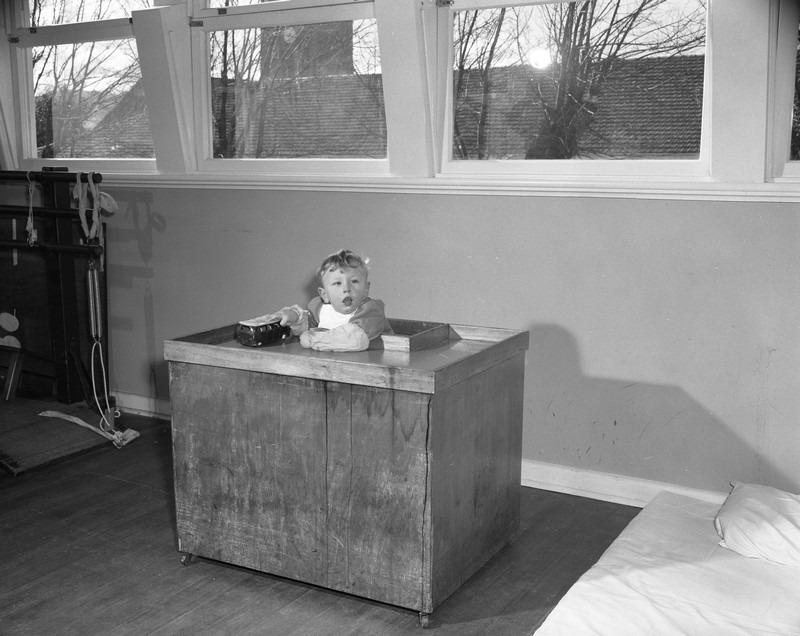
- Wingfield Home, Physiotherapy Department gym, standing box stimulates posture reflexes in training to stand and walk
- Type
- Image
- Date
- 1951 - 1973
- Control
- TAHO Reference: AB713-1-7668
- Source
- Tasmanian Images: Tasmanian Archive and Heritage Office
- Title
- Wingfield Home, Physiotherapy Department gym, assisting medical officer checks the use of a walking 'moveline' for a baby
- Type
- Image
- Date
- 1951 - 1973
- Control
- TAHO Reference: AB713-1-7670
- Source
- Tasmanian Images: Tasmanian Archive and Heritage Office
- Title
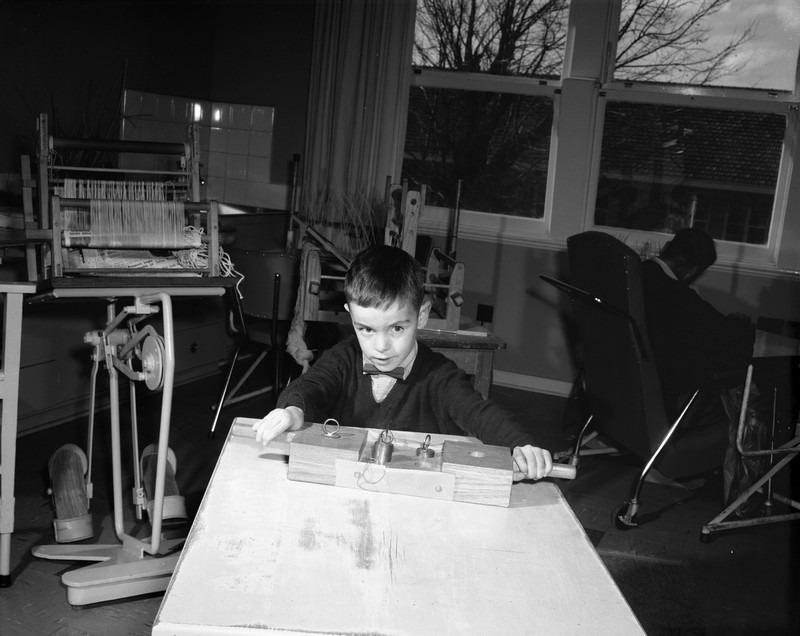
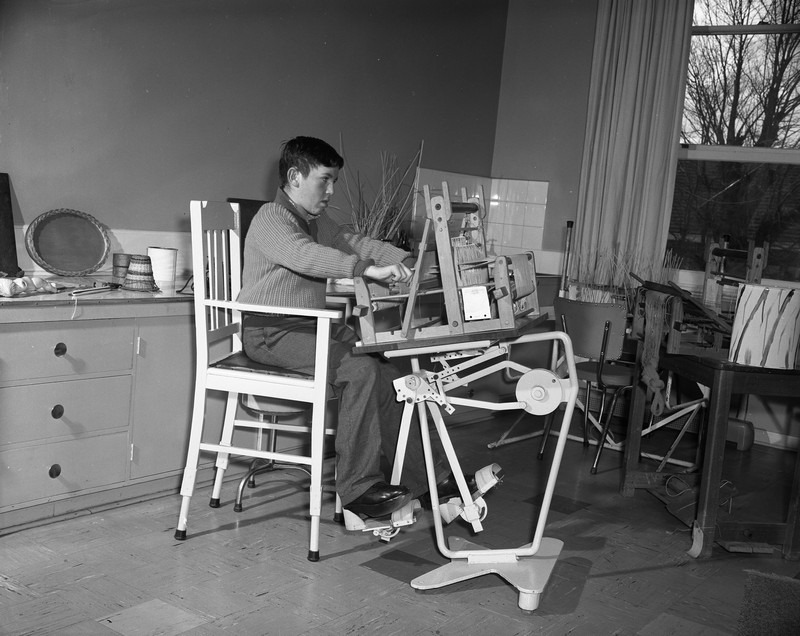
- Wingfield Home, Occupational therapy, weaving on the kick machine, co-ordination of hands and legs
- Type
- Image
- Date
- 1951 - 1973
- Control
- TAHO Reference: AB713-1-7671
- Source
- Tasmanian Images: Tasmanian Archive and Heritage Office
- Title
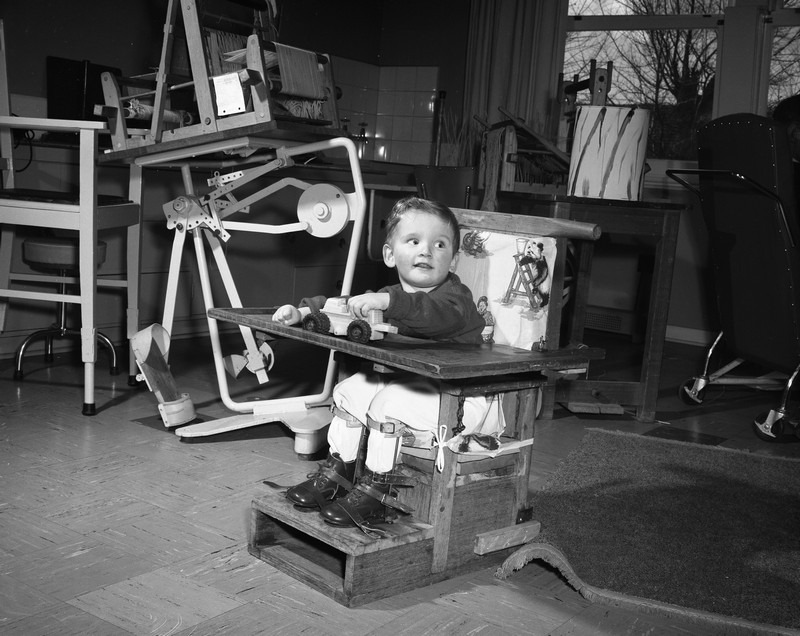
- Wingfield Home, Occupational therapy, child in posture chair with tray
- Type
- Image
- Date
- 1951 - 1973
- Control
- TAHO Reference: AB713-1-7672
- Source
- Tasmanian Images: Tasmanian Archive and Heritage Office
- Title
- Wingfield Home, Occupational therapy, sandpapering to encourage extension of elbow and wrist
- Type
- Image
- Date
- 1951 - 1973
- Control
- TAHO Reference: AB713-1-7674
- Source
- Tasmanian Images: Tasmanian Archive and Heritage Office
- Title
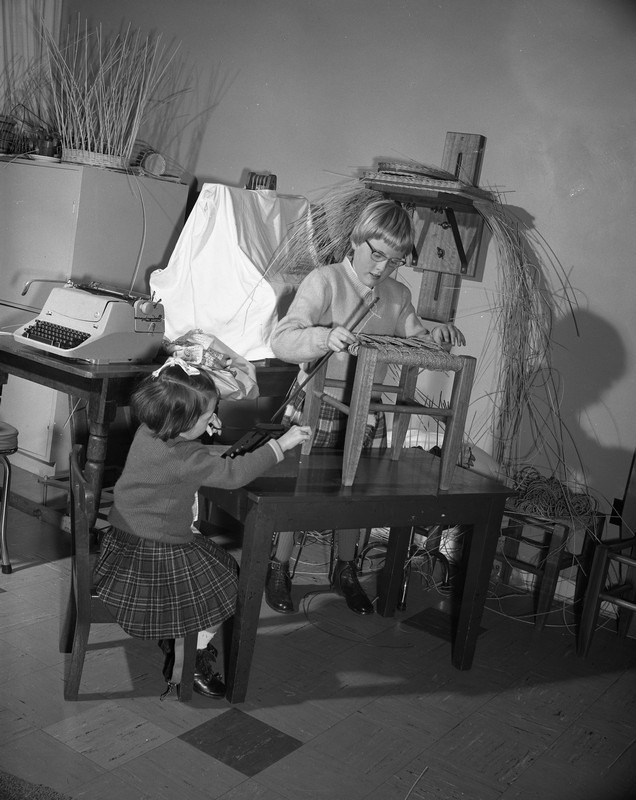
- Wingfield Home, Occupational therapy, the dining room is used for the teaching of children in the use of table procedure at each meal time
- Type
- Image
- Date
- 1951 - 1973
- Control
- TAHO Reference AB713-1-7675
- Source
- Tasmanian Images: Tasmanian Archive and Heritage Office
- Title
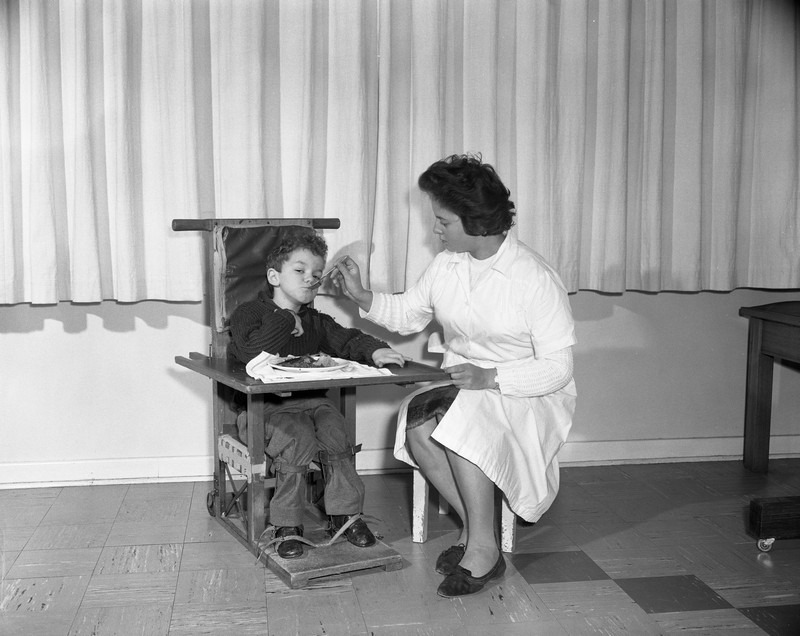
- Wingfield Home, Occupational therapy, the feeding of each child who cannot complete his own meal is important
- Type
- Image
- Date
- 1951 - 1973
- Control
- TAHO Reference: AB713-1-7676
- Source
- Tasmanian Images: Tasmanian Archive and Heritage Office
Sources used to compile this entry: 'Vice-Regal visit to Wingfield House', The Mercury, 13 November 1940, p. 4, http://nla.gov.au/nla.news-article25833254; 'Wingfield House: Dr Cumpton praises work of Tasmanian society', The Mercury, 11 November 1940, p. 4, http://nla.gov.au/nla.news-article25832887; 'Separation of inmates: need at Wingfield', The Mercury, 30 April 1941, p. 8, http://nla.gov.au/nla.news-article25859060; Killalea, Anne, The great scourge: the Tasmanian infantile paralysis epidemic 1937-, Tasmanian Historical Research Association, Hobart, 1995, 165 pp; Pearce, Kim and Doyle, Susan, New Town: a social history, Hobart City Council, Hobart, 2002, 144 pp.
Prepared by: Caroline Evans
Created: 29 February 2012, Last modified: 20 December 2012