


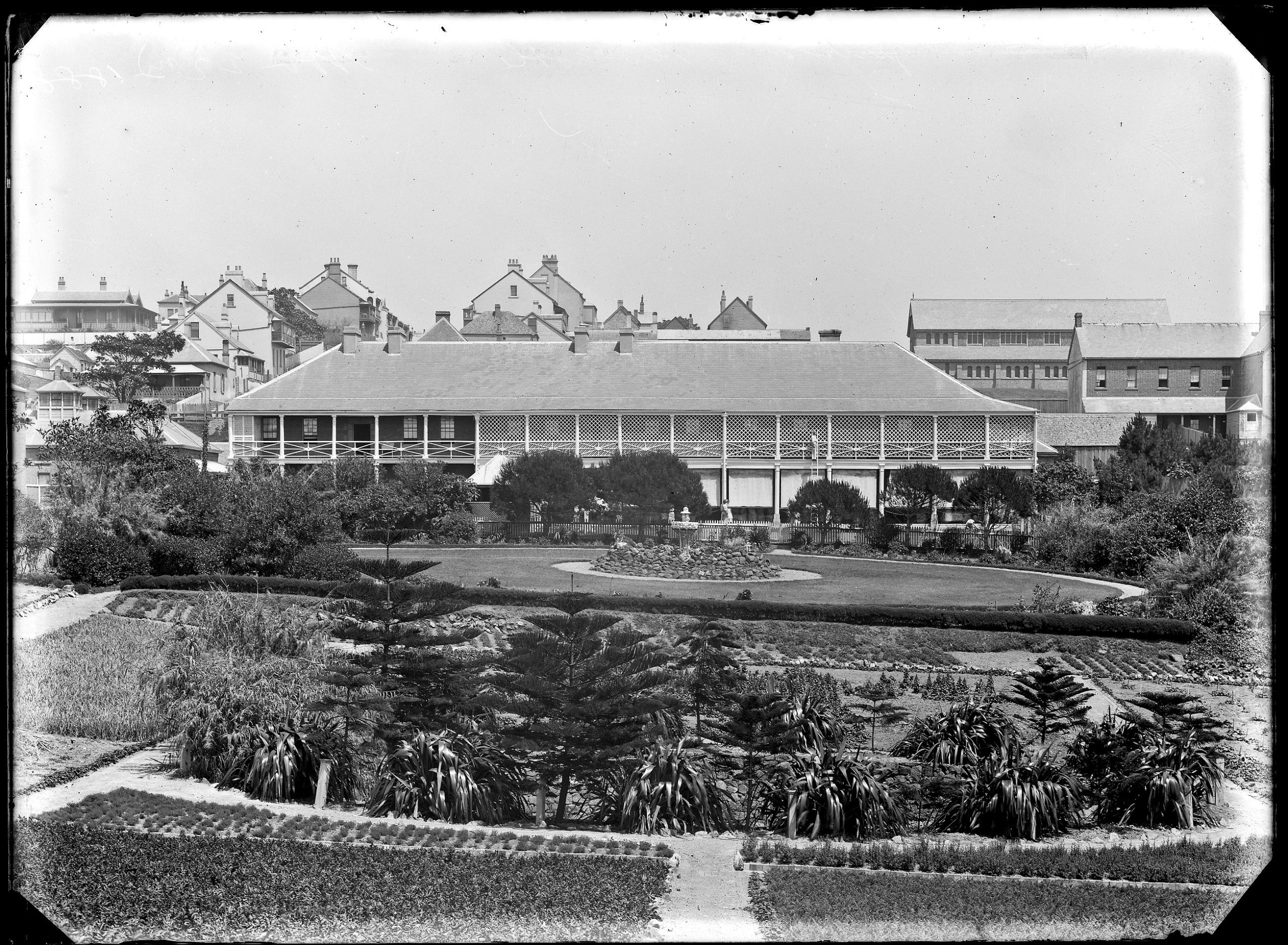
Newcastle Mental Hospital was established in 1871 in buildings that had previously been the Newcastle Industrial School and Reformatory for Girls, and prior to that the government barracks. It was opened to ease overcrowding at asylums in Sydney, and intended to specifically accept patients with developmental disabilities (referred to at the time as “imbeciles” and “idiots”), as opposed to those with acute psychiatric conditions or mental illnesses that onset later in life. Its establishment was somewhat hasty and under-planned, taking advantage of the opportunity presented by the vacant buildings when the Girls Reformatory was moved from the site. It first operated under the name of the Newcastle Asylum for Imbeciles and Idiots, and was run first by the Colonial Secretary, and then by the Inspector General of the Insane when that role was established in 1876. Its name was changed in 1915 to the Newcastle Mental Hospital, then in 1969 to the Newcastle Psychiatric Centre. It was also commonly known as the Watt Street Hospital, due to its location on Watt Street. In 1989 the Newcastle Psychiatric Centre became the James Fletcher Hospital.
When the Newcastle Asylum opened in 1871 eight children from Parramatta Asylum were among the first patients transferred there, along with a large group of older adult men. The Correspondence Files of the Colonial Secretary show that children as young as 2 years old continued to be regularly admitted to Newcastle. Some of these children were transferred to Newcastle from other mental health hospitals in New South Wales such as Gladesville and Parramatta, as well as from destitute or benevolent asylums and government-run children’s homes and industrial schools. The remainder had been admitted directly by their families. These records, as well as patient records from Newcastle Mental Hospital, are held by Museums of History NSW (State Archives).
In 1887 it was reported in The Sydney Morning Herald (‘The Newcastle Asylum for Imbeciles’, 27 August 1887) that about one third of the 236 patients at the asylum were children over the age of 4. Despite the large number of children at the hospital there was no special ward for them – they stayed in the same section as the adult female patients. The outlook for patients described in the article was that they would remain there for life.
In 1908 a kindergarten school was established for the younger children at the Hospital, to provide them with a basic education and teach them general life skills and enable them to perform basic daily tasks for themselves. Up to this time there had been very few education opportunities for children, however in the 1890’s workshop and crafts training were introduced in areas such as needlework, gardening, and shoe-making. Some patients were allocated jobs around the hospital, such as in the kitchens, grounds, and laundries. Outside of their work and schooling times, patients were encouraged to attend church services on Sundays and occasional concerts would be held for both their entertainment and to provide opportunities for musical participation. Team sports and outdoor games was another form of entertainment available to patients.
By the mid 20th Century the majority of patients admitted to the Newcastle Mental Hospital were children. A PhD thesis written by Gina Andrews Zucker (‘A Case Study of the Impact of Administrative Frameworks on a Group of Intellectually Disabled Children Admitted to an Australian Mental Hospital in 1952’, 2020) explores the experiences of 13 of the 86 children admitted to the hospital in 1952. Only two adult patients were admitted in this year. This trend was consistent in admissions to the hospital throughout the 1940s and 1950s. Of these 86 children, most had been admitted directly by their families (82), while the remaining four were wards of the state who were admitted by the Child Welfare Department. The most common reason given for admission of children to the hospital was that their families were unable to provide for the child’s needs at home. Institutionalisation of their child was the only option available to these families.
At this time the Newcastle Mental Hospital appears to have been acting, at least in part, as a Receiving Home for children with developmental disabilities. Andrews Zucker found that approximately one third of children admitted in 1952 were transferred to other mental health institutions while children. Girls were often transferred to Stockton Mental Hospital, typically at 6 to 7 years old, while boys were transferred to Peat and Milson Islands Mental Hospital, typically when they were 11 to 12 years old. Both of these hospitals were primarily adult hospitals. Of those patients who were not transferred to other institutions, some remained at the hospital long term, some died in childhood, a small number were returned to their families, and some were transferred to community-based group homes when they were established in the 1980s and 1990s.
Andrews Zucker describes five wards at Newcastle Mental Hospital, each holding between 30 and 50 children, and located in the oldest part of the hospital that had been the Barracks and Industrial and Reformatory School buildings. Wards One and Two were for toddlers and young children, as well as some very physically disabled older children, Ward Three was for boys aged 7 to 12, Ward Four was for older boys boys prior to their transfer to Peat and Milson Islands, and Ward Five was for post-pubescent and adult patients who could be utilised as ‘workers’ at the hospital.
Despite the hospital housing mostly children in the 20th century (320 children were living there in 1954), playgrounds were only established in the late 1950s. Prior to this, children typically spent their days on the concrete courtyards, and other leisure activities such as movie screenings, concerts, and social events were held in the recreation hall. Excursions for patients into the broader community, such as to shops or entertainment venues such as cinemas, were introduced around 1960. Research conducted by Gina Andrews Zucker found that roughly one quarter of children at the hospital attended some form of school on site. This schooling included pre-school, kindergarten, a primary school that taught reading and writing, and an occupational school that taught practical skills that would enable them to work at the hospital. Occasionally children would be taken out on leave with their families, or receive visits from them, however in interviews former nurses of the hospital have stated that this was not a common occurrence.
In 1989 Newcastle Psychiatric Centre was renamed the James Fletcher Hospital. James Fletcher Hospital continues to provide in-patient and out-patient psychiatric services in 2026. Find & Connect have not found evidence of James Fletcher Hospital providing long-term residential care for children.
From
1871
To
1989
Alternative Names
Newcastle Asylum for Imbeciles and Idiots
Newcastle Psychiatric Centre
Watt Street Hospital
James Fletcher Hospital
