


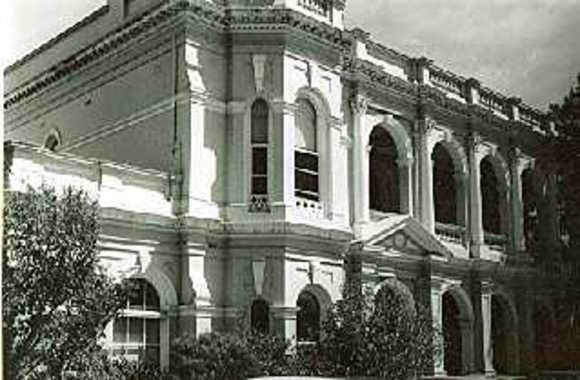
The Young Christian Workers’ Movement Hostel, Hawthorn, was established in 1948. It was located in a house known as ‘The Terricks’ at the corner of Paterson and Oxley Road. It offered temporary housing to youth migrants from Britain. The Hostel closed in 1955.
According to Good British Stock (1999), the YCW contacted Immigration Minister Arthur Calwell in 1948, requesting advice about a scheme to immigrate young workers to Australia from overseas. The YCW were planning on purchasing a building to house 25 to 30 young men. The plan was for youth migrants to stay at the Hawthorn hostel for a period of around 3 months, “until they become used to Australian conditions, when they will then be placed in private boarding homes” (Advocate, 19 October 1950). The YCW were provided with government funding in 1949 to purchase the property known as The Terricks, a guesthouse in the suburb of Hawthorn (p.130). The Commonwealth and state governments each contributed one third of the capital cost and furnishings for the property (The Argus, 28 January 1950).
Following World War Two, Australia was looking to migration as a way to increase its population and respond to labour shortages, particularly for skilled tradesmen, apprentices and rural workers. The YCW corresponded with the Commonwealth government in 1949 about bringing Baltic and Maltese workers to Australia to stay at the Hawthorn hostel and in 1949-50 FCW Director Fr FW Lombard visited the UK to assess the possibilities of bringing young British workers to Australia on lines similar to that of the Big Brother Movement (Good British Stock, p.119). However, the YCW was not approved to receive youth migrants until March 1950 (p.131).
In September 1950, a group of 15 youth migrants, from England, Scotland and Northern Ireland, arrived in Melbourne (The Advocate, 21 September 1950), and another group of 18 arrived before Christmas that year. The hostel was officially opened in December 1950, and it was reported that the Hawthorn hostel could accommodate up to 60 migrants, and the YCW was hoping for a “continuity of supply” so that 200 youths from Britain could pass through the hostel per year (The Advocate, 7 December 1950). At the end of 1952, the Children’s Welfare Department reported that the hostel had received 124 child migrants. In December 1952, there were 49 boys in residence (source: annual reports).
Lombard had hoped to bring “up to 150 youths” from Britain per year, however the YCW Hostel received fewer young men than planned, and it ran at a loss. The low wages that the young men received while working as apprentices meant that the YCW had to subsidise the management costs of the Hawthorn hostel (Advocate, 7 December 1950). Fr Lombard wrote to the Commonwealth government in May 1951 about the Hostel’s financial difficulties:
I visited Britain to organise a scheme for obtaining nominations… a total of 49 nominated British migrants have arrived. Already 15 boys have left the hostel, five are working with farmers; nine apprenticed; nine (others) working with the PMG; ten are in private homes in the suburbs. However, the financial burden is a heavy one.
In 1952, the YCW corresponded with the Commonwealth government about its financial problems, and advised that it wanted to withdraw as quickly as possible from youth migration. The YCW had to sell the Hawthorn property and repay a substantial part of the original government grant (Good British Stock, p.119).
The Hawthorn hostel was closed in 1955.
From
1948
To
1955
Alternative Names
YCW Hostel
YCW Migration Hostel
1948 - 1955
The YCW Hostel was located on the corner of Paterson and Oxley Roads, Hawthorn, Victoria (Building Still standing)